
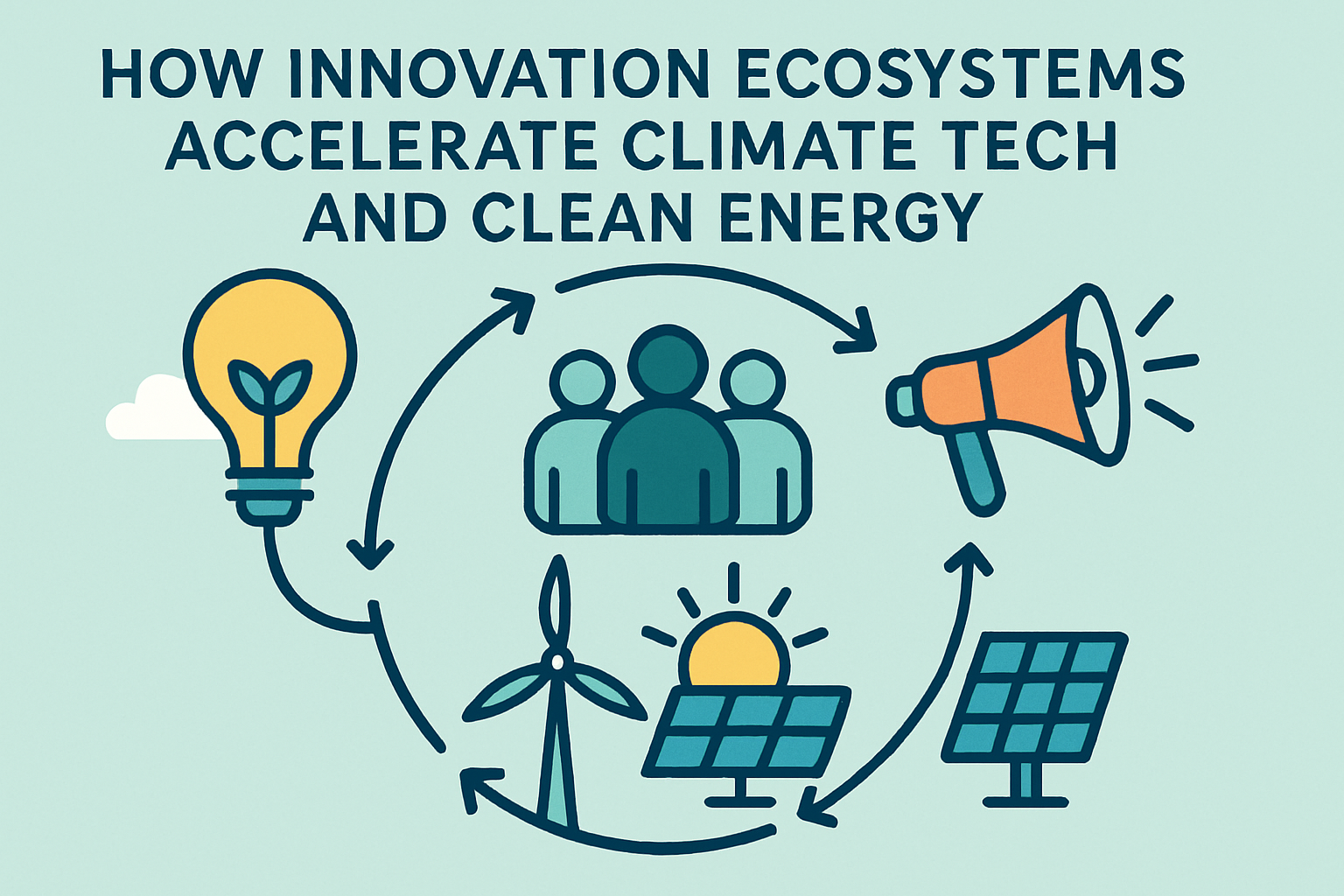
Sustainable Innovation Ecosystems: The Key to Saving Earth’s Resource
Introduction: The Age of Innovation and the Cry of the Earth
In a century defined by breathtaking technological leaps, humanity stands at a crossroads. On one side lies extraordinary progress—AI, renewable energy, digital transformation, and global connectivity. On the other lies a deepening environmental crisis—melting glaciers, polluted air, vanishing biodiversity, and ecosystems on the brink of collapse.
But what if the solution to saving our planet already exists—within the same force that created this transformation?
That force is innovation, and more importantly, the ecosystems that nurture it.
Clean-energy startups in Scandinavia are leading the charge. In Africa, sustainable agriculture networks are growing. Together, they are part of a quiet revolution. These are innovation ecosystems designed not just for profit, but for the planet. These powerful networks of entrepreneurs, researchers, policymakers, and investors are reimagining how human progress can coexist with nature.
This is the story of how innovation ecosystems are evolving into the green engines of progress. They are driving climate resilience, circular economies, and sustainable futures for all.
What Is an Innovation Ecosystem?
Think of a forest. Each tree, plant, insect, and microbe plays a role in keeping it alive. Some produce oxygen, others recycle nutrients, and still others protect the roots from erosion. Together, they form a self-sustaining ecosystem.
UNICEF Climate Innovation Challenge
Now imagine this concept in human innovation.
An innovation ecosystem is a dynamic network of people, organizations, and institutions working together to transform ideas into real-world solutions. Entrepreneurs bring creativity, universities contribute research, corporations offer scale and resources, investors fund promising ideas, and governments create supportive policies.
When these forces connect harmoniously, ideas don’t just survive—they thrive.
The Four Green Pillars of Innovation Ecosystems
1. Value Creation for All Life
Innovation must go beyond profit—it must create shared value. Successful green ecosystems deliver environmental, economic, and social impact together: clean air, dignified jobs, and fair growth.
Example: The Netherlands’ “Circular Economy 2050” initiative uses public-private partnerships to reduce waste across industries. This effort creates new jobs and reduces emissions.
2. Knowledge Transfer Across Boundaries
Just as rivers connect landscapes, knowledge flows sustain innovation ecosystems. When universities share research with startups, and local farmers learn from clean-tech pioneers, progress accelerates.
Digital platforms and open-access research allow sustainability innovations in one corner of the world. These innovations can inspire breakthroughs elsewhere. This creates an interconnected learning forest of ideas.
3. Co-Creation: Designing Together for the Planet
Co-creation means diverse minds solving problems together. Scientists, engineers, artists, and indigenous communities often bring unique perspectives to environmental solutions.
Case Study: In Kenya, the “Green Energy Village” initiative merges local craftsmanship with solar technology. It provides off-grid power and income for rural families.
4. Competitive Positioning for Sustainable Advantage
In the green economy, competitive advantage means leadership in clean energy, biodiversity protection, and sustainable design. Nations and companies that build strong innovation ecosystems around sustainability will dominate the 21st century’s growth story.
Insight: The World Economic Forum projects that the global green innovation economy will reach $12 trillion by 2030.
Anatomy of a Thriving Green Innovation Ecosystem
A successful sustainability-driven innovation ecosystem has five key components:
- Diverse Actors – Entrepreneurs, governments, research centers, NGOs, and impact investors.
- Abundant Resources – Access to clean energy funding, digital tools, sustainable materials, and eco-friendly infrastructure.
- Enabling Activities – R&D, circular economy experiments, green product design, climate technology incubation.
- Supportive Infrastructure – Accelerators for cleantech startups, sustainability labs, and green finance institutions.
- Collaborative Culture – Trust, inclusivity, and a shared purpose rooted in environmental stewardship.
Why Innovation Ecosystems Matter for Climate Action
Accelerating Climate Solutions
Traditional models of environmental progress—slow policy changes and fragmented research—can’t match the urgency of today’s climate crisis.
Innovation ecosystems accelerate this process.
Example: In India, the Clean Energy International Incubation Centre (CEIIC) links startups, research labs, and investors to fast-track affordable renewable technologies.
Transforming Economies
Innovation ecosystems don’t just generate green technologies—they transform economies. From electric mobility in China to eco-tourism in Costa Rica, entire industries are being rebuilt around sustainability principles.
Driving Collective Resilience
The strength of an ecosystem lies in collaboration. During crises—pandemics, floods, or droughts—these networks mobilize faster than isolated organizations. That resilience is now essential for humanity’s survival.

The Science Behind Innovation Ecosystems
Openness and Interdependence
Recent research shows that open innovation ecosystems outperform closed systems by 22% in survival and success rates. When data, insights, and talent are shared, sustainability breakthroughs occur faster and at lower cost.
Governance Matters
However, 85% of innovation ecosystems fail due to poor governance—unclear roles, uneven value distribution, or lack of transparency.
Green ecosystems overcome this by embedding fairness and shared benefits into their DNA.
Example: The European Green Deal’s governance model aligns corporate and public goals for a unified sustainability roadmap.
Innovation Ecosystems in Action
Healthcare and Environmental Health
Green innovation ecosystems also redefine public health. Projects linking clean water tech, urban farming, and pollution monitoring demonstrate that human and planetary health are inseparable.
Fintech and Climate Finance
Sustainability-linked bonds, green credits, and carbon markets are expanding through fintech ecosystems. Blockchain, AI, and finance converge in these ecosystems. They fund climate-positive projects transparently.
Technology and AI for Sustainability
Artificial intelligence now maps deforestation, optimizes energy grids, and predicts climate migration. These advances thrive in ecosystems connecting technologists, ecologists, and policymakers.
Example: Google’s “AI for the Planet” initiative collaborates with NGOs and scientists worldwide to deploy AI for conservation and climate forecasting.
Section 11: Innovation Ecosystems for a Sustainable Planet
From Exploitation to Regeneration
For centuries, humanity extracted from the Earth with little thought of balance. Today, innovation ecosystems represent a historic turning point—a move from exploitation to regeneration.
They don’t just reduce harm; they restore ecosystems. From reforestation drones to ocean-cleaning robotics, innovators worldwide are building technologies that give back more than they take.
Green Innovation and the Circular Economy
Innovation ecosystems are key to the circular economy, where materials are reused, energy is renewable, and waste becomes a resource.
Example: Sweden’s “ReTuna,” the world’s first recycling mall, thrives as an ecosystem of entrepreneurs repurposing discarded goods into new products.
Climate Resilience and Local Empowerment
Resilience isn’t built by governments alone—it’s co-created by local innovation.
Community solar projects, intelligent irrigation systems, and carbon-neutral transport hubs all emerge from localized innovation ecosystems empowered by global networks.
Education and the Next Generation of Green Innovators
Sustainability education—integrating STEM with environmental ethics—is essential. Innovation ecosystems must include universities and youth accelerators that nurture the next wave of eco-entrepreneurs.

Conclusion: Innovation as the Earth’s Renewal System
Innovation ecosystems are not merely engines of economic progress—they are the circulatory system of a living planet.
They reveal that our most powerful technologies and ideas emerge not from isolation. Instead, they come from collaboration with each other and with nature itself.
Emerging Climate Hazards: Strategies for Worker Protection and Preparedness
To restore the Earth, we must innovate like the Earth: interconnected, adaptive, and regenerative.


Leave a Reply